Before you pay: 7 checks on your service charge demand
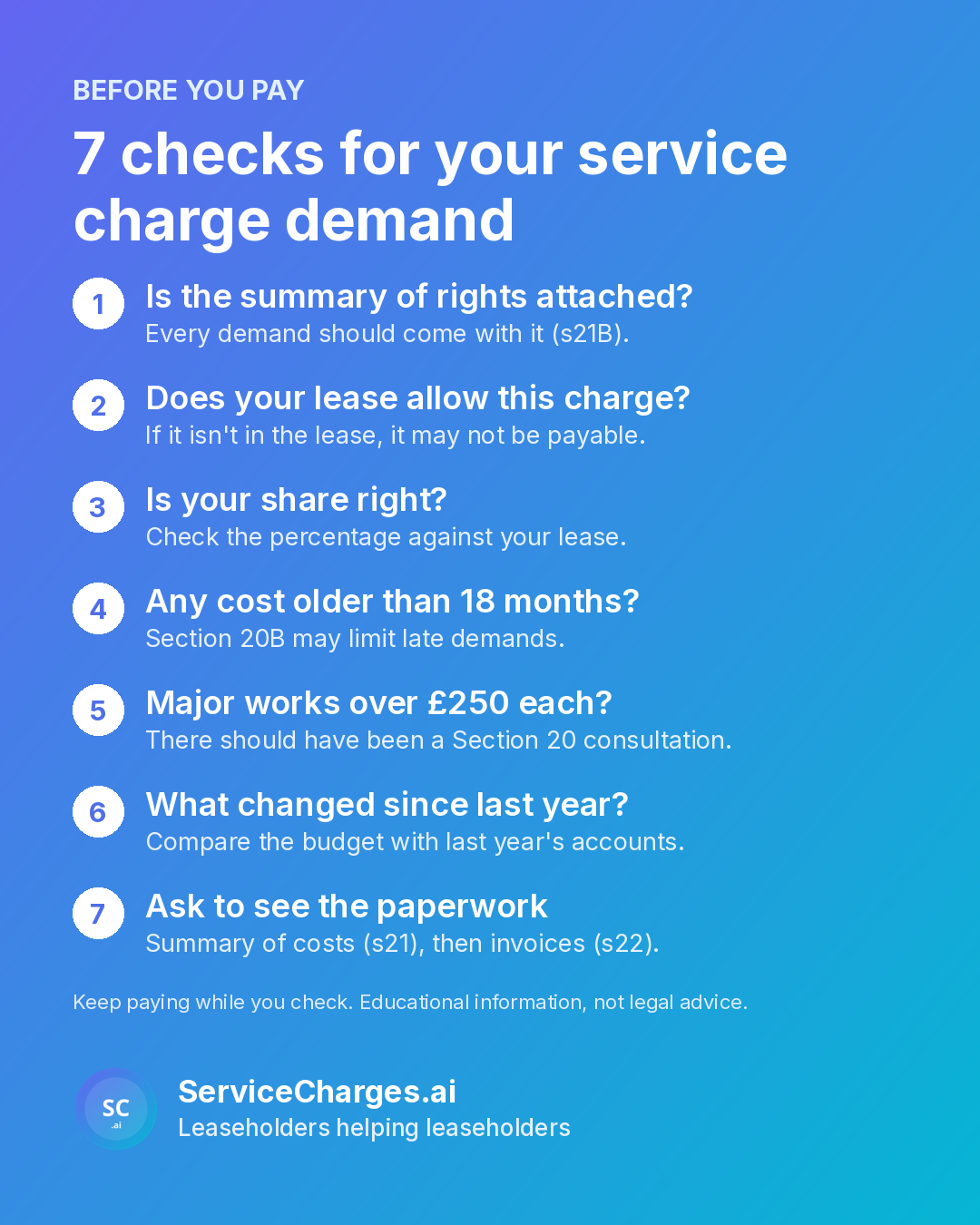
Seven plain-English checks to make before paying a service charge demand, from the summary of rights to the 18-month rule and Section 20. With a template letter.
For many blocks, autumn is when the paperwork arrives: last year’s accounts, a balancing charge, or next year’s budget. If the number has gone up again, you’re not alone. Service charges have risen 41% since 2019, against 23% inflation, and the average annual charge was around £2,300 in 2024 (The Property Institute and Hamptons, 2024).
A higher bill isn’t automatically a wrong one. Buildings cost more to insure, repair and run than they used to. But the law gives you clear ways to check what you’re being asked to pay, and many of the most common problems can be spotted at the kitchen table with the demand and your lease in front of you. These are the seven checks we’d make before paying.
First, the most important point: keep paying while you check. Withholding payment can put you in breach of your lease. Paying doesn’t, on its own, stop you challenging a charge later; what you mustn’t do is agree or admit a charge you want to question. If you’re worried, say in writing that you’re paying under protest.
Check 1: is the summary of rights attached?
In England, every service charge demand must come with a prescribed summary of your rights and obligations (section 21B of the Landlord and Tenant Act 1985). It’s usually a separate sheet headed “Service Charges – Summary of tenants’ rights and obligations”. The demand should also give the landlord’s name and an address in England and Wales where notices can be sent.
If the summary is missing, you may withhold that charge until it’s provided. Once it is, the charge becomes payable. Treat it as a reason to ask for a correct demand, not a way to avoid the bill.
Check 2: does your lease allow this charge?
Service charges are contractual. Your lease sets out what can be charged, how it’s worked out and when it’s due. Find the service charge clause and the schedule listing the services. If a cost isn’t covered there (improvements, for example, are often treated differently from repairs), it may not be payable. Lease wording varies a great deal, so read your own rather than relying on a neighbour’s.
Check 3: is your share right?
Your lease also sets your share of the costs: a fixed percentage, a fraction, or a “fair proportion”. Check that the share used on your demand matches. A small error repeats every year, and it’s one of the easiest things to put right once spotted.
Check 4: is anything more than 18 months old?
Under section 20B, if a cost was incurred more than 18 months before you were asked to pay it, it generally can’t be recovered from you. The exception is where, within those 18 months, you were told in writing that the cost had been incurred and that you’d be asked to contribute (a section 20B(2) notice). Balancing charges and year-end adjustments are where old costs most often appear, so check the invoice dates.
Check 5: major works or long contracts – was there a consultation?
If works will cost any one leaseholder more than £250, the landlord must consult first under section 20. The same applies to long-term agreements of more than 12 months that cost any one leaseholder more than £100 a year. Without a proper consultation, your contribution may be capped at £250 for works (or £100 a year for the agreement) unless the tribunal grants dispensation.
Consultation has stages, each with 30 days for your written comments, and at the first stage you can nominate a contractor. If you never received notices for a large item on your bill, ask why. We’ll cover Section 20 in detail in week 3.
Check 6: what changed since last year?
Put this year’s budget next to last year’s accounts, line by line. Big jumps in insurance, management fees, repairs or the reserve fund contribution all deserve a question. The test the law applies is reasonableness: under section 19, costs count only if they were reasonably incurred, and works and services must be of a reasonable standard. An advance demand should be no more than is reasonable.
Check 7: ask to see the paperwork
Under section 21, you can ask in writing for a summary of the costs behind your service charge. The landlord must reply within one month of your request, or within six months of the end of the accounting period, whichever is later. Within six months of receiving the summary, section 22 lets you ask to inspect the accounts, receipts and invoices behind it, and take copies.
Send your request in writing, keep a copy and note the date. Often the invoices explain a rise and the question ends there. A template letter is below.
What to do with what you find
- Write to the landlord or managing agent. Keep it factual: list each item, what concerns you and what you’re asking for.
- Talk to your neighbours. A concern shared by several leaseholders carries more weight, and a recognised tenants’ association has extra rights.
- Get free initial advice from LEASE (lease-advice.org), and consider mediation.
- If it can’t be resolved, the First-tier Tribunal (Property Chamber) can decide what’s payable. It costs £114 to apply and £227 if there’s a hearing (HMCTS). Next week we look at what the published tribunal record shows about how those challenges turn out.
How we can help
If you’d like a second pair of eyes, our free audit reads your demand, accounts and lease and shows what looks challengeable, and why. It takes minutes and needs no card, and a person reviews every report before it reaches you. Start at servicecharges.ai.
ServiceCharges.ai is not a law firm. Leaseholders helping leaseholders. This article is educational information, not legal advice.
Template letter: section 21 request
[Your name] · [Your address] · [Date]
To: [Landlord or managing agent name and address]
Re: Request for a summary of relevant costs under section 21 of the Landlord and Tenant Act 1985 – [Property address]
I am the leaseholder of [flat number and building]. Under section 21 of the Landlord and Tenant Act 1985, please provide a written summary of the relevant costs incurred in connection with the service charges payable for the accounting period [start date] to [end date].
Please provide the summary within the time limit set by the Act. Once I have received it, I may ask to inspect the supporting accounts, receipts and other documents under section 22. Please confirm that you have received this request.
Yours sincerely, [Your name]
Note under the letter: a starting point, not legal advice. If you’re unsure about wording, LEASE gives free initial advice.
Want a second pair of eyes?
The free audit reads your demand, accounts and lease and shows what looks challengeable, and why. It takes minutes and needs no card, and a person reviews every report before it reaches you.
Start my free audit